Borneo is the world’s third-largest island, and even after you subtract the northern coastal strip belonging to Malaysia and Brunei, the Indonesian portion alone is roughly the size of France.
This massive Borneo rainforest ecosystem stretches across Kalimantan, Sabah, and Sarawak, creating one of the most biodiverse landscapes on the planet. For travelers seeking Borneo wildlife tours, the island offers a rare chance to see ancient jungle, winding rivers, and cultures that have lived in harmony with the forest for thousands of years.
The human story of Borneo is rooted in the Dayak people, descendants of the island’s first inhabitants. Many Dayak communities still live deep in the interior forests and coastal swamps, practicing subsistence farming, fishing, and forest foraging.
Yet the majority of Borneo’s population now resides in river towns and port cities at the mouths of major waterways like the Mahakam, Kapuas, and Barito rivers. This mix of traditional and urban life makes Borneo cultural tourism unique—you can visit a longhouse one day and explore a bustling market city the next.
Borneo’s dense tropical rainforest supports an extraordinary range of wildlife. Scientists have recorded 221 mammal species and 450 bird species here, with nearly 50 mammals found nowhere else on earth. Key Borneo endemic species include the proboscis monkey with its distinctive long nose, the clouded leopard, estuarine crocodile, and various monitor lizards.
The canopy and understory are equally rich, housing hornbills, kingfishers, pitcher plants, and ironwood trees that can live for centuries. For anyone planning a Borneo nature expedition, this concentration of rare flora and fauna is unmatched in Southeast Asia.
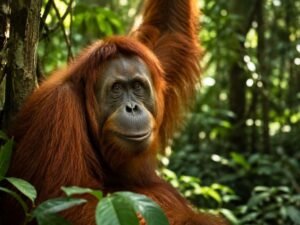
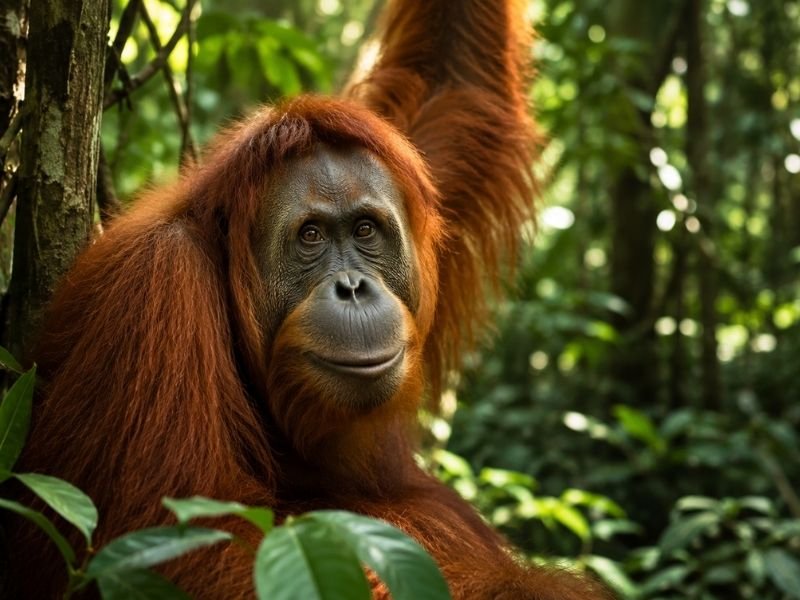
The most iconic resident of the island is the Bornean orangutan, scientifically known as Pongo pygmaeus. Ten thousand years ago orangutans ranged across Southern China and mainland Southeast Asia, but today they survive only in fragmented populations on Borneo and Sumatra.
Both species are classified as critically endangered orangutans, and continued deforestation puts them at risk of extinction within decades. The name “orangutan” comes from Malay: orang meaning person and utan meaning forest, literally “person of the forest.”
Physically, Bornean orangutans are built for an arboreal life. Adults reach 1.25 to 1.5 meters tall with thick necks, long powerful arms, short bowed legs, and bodies covered in reddish-brown hair. They lack tails and move through the canopy using their arms for brachiation.
As great apes, they share close genetic ties with gorillas and chimpanzees. In Borneo, you can find them in lowland dipterocarp forests, hilly areas, peat swamp forests, and even mangrove fringes up to 500 meters above sea level. This adaptability is why orangutan trekking in Borneo is possible in multiple national parks.
Conservationists recognize three subspecies of the Bornean orangutan. Pongo pygmaeus pygmaeus lives north of the Kapuas River into northeastern Sarawak. Pongo pygmaeus wurmbii occupies the area south of the Kapuas to the western Barito River.
Pongo pygmaeus morio ranges across Sabah, Sarawak, and most lowland forests of Borneo except in the south. Despite being omnivores, their diet consists mainly of fruit, bark, leaves, flowers, insects, nectar, mushrooms, and honey. Durian is a favorite, and fruiting seasons determine much of their movement through the forest.
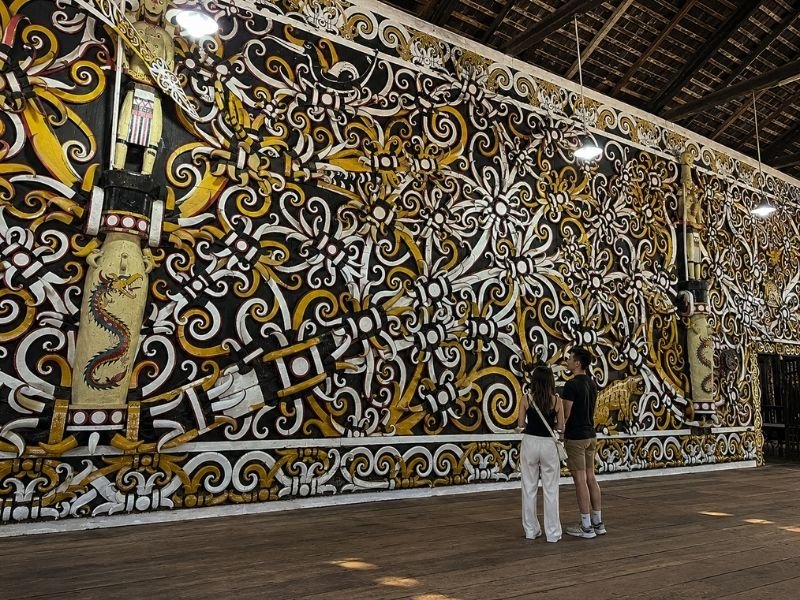
The Dayak people are equally integral to Borneo’s identity. The name “Dayak” originally meant “inland” or “upriver people,” distinguishing forest communities from coastal traders. Classifying Dayak groups is complex because of centuries of migration, warfare, and cultural exchange. Languages, art styles, rituals, and histories vary widely between sub-groups.
Yet a shared environment of jungle, rivers, and rice-based agriculture has produced common spiritual beliefs centered on spirits that inhabit trees, rivers, and mountains. For visitors interested in Dayak cultural tours, this living heritage is visible in longhouses, weaving, and ceremonies.
Although traditional warfare has ended, many Dayak villages still relocate periodically to access markets, jobs, and outside goods. Religious practices have evolved with the arrival of Christianity and Islam, but animist elements remain.
A common concept of a Supreme Creator exists, though it rarely receives direct worship. Instead, daily life is shaped by respect for forest spirits and ancestral customs. One well-preserved example is the Tanjung Isuy longhouse, built 300 meters from the Mahakam River pier. Constructed on short meranti wood pillars, it features carvings of crocodiles, dragons, apes, and hornbills at its entrance.
Today the longhouse functions as both a cultural center and visitor accommodation. The rear wing has been converted into guest rooms with beds and mosquito nets, allowing travelers to experience Dayak homestay tourism authentically.
The main hall often doubles as a marketplace where Dayak Benuaq women sell handwoven textiles made from doyo leaves, a plant similar to pandanus. Fibers extracted from doyo are spun into thread and woven into cloth, hats, and wall hangings—each piece reflecting patterns passed down through generations.
For anyone exploring Borneo, the island offers more than wildlife sightings. A well-planned Borneo eco-tour combines orangutan rehabilitation centers like Tanjung Puting and Danum Valley, river cruises through peat swamps, and stays in Dayak longhouses. You’ll witness how forest conservation and cultural preservation are intertwined here.